.jpg)
Community Stewardship Initiative: Making Community Stewardship Visible, Measurable and Actionable


Type of project
Implementation
Thematic area
Community Stewardship
Project area
Meghalaya and Odisha
Project status
Ongoing
.jpg)
About the Project
The Community Stewardship Initiative is a long-term landscape governance and stewardship programme grounded in a foundational conviction: that Indigenous Peoples and Local Communities (IPLCs) are not passive beneficiaries of conservation, they are the primary stewards of the forests, commons and ecological landscapes they have inhabited and cared for across generations. The initiative seeks to make that stewardship visible, measurable and actionable, so that communities can engage on equal terms with the policy, funding and market systems that shape their landscapes.
The initiative began in 2021, when LGT Venture Philanthropy, FES and Landstack set out to ask whether carbon markets could be made to work for communities and whether communities were equipped to engage with them on their own terms. What that inquiry revealed was a deeper problem: the rapid expansion of technocratic and market-led climate finance into tribal and forest-dependent regions was proceeding without any recognition of the customary governance systems, ecological knowledge, care labour and tenure realities that had actually sustained these landscapes. The response was to build evidence, a community stewardship evidence base grounded in care, knowledge and agency, that could challenge the dominant narrative and support communities in designing their own conservation and PES pathways.
Over four toolkit iterations and deployments across more than 30 villages in Odisha, Meghalaya, Nagaland and Manipur, the initiative has grown from a stewardship evidence generation exercise into a community-led planning and ecosystem governance framework. It now integrates with Community Forest Resource Management Planning (CFRMP) and other state-recognised landscape governance processes and has seeded a regional coalition, CLANS, for operationalising a dedicated Stewardship Fund for Northeast India.
Objectives and goals

-
Document and make visible the unpaid care labour, ecological knowledge and governance practices through which communities steward forests and commons
-
Build a rigorous, community-generated evidence base that challenges the invisibility of community stewardship in mainstream conservation and climate finance frameworks
-
Integrate stewardship evidence into community-led landscape planning — including formal CFR Management Planning — so that communities govern and negotiate from a position of knowledge
-
Equip communities to engage with — and shape the terms of — ecosystem service and climate finance mechanisms, including carbon markets and PES arrangements
-
Strengthen customary governance, community-designed ecological monitoring and stewardship-based conservation systems as alternatives to top-down conservation models
-
Build coalitions and institutional platforms — including a dedicated Community Stewardship Fund — that can channel long-term, direct and flexible support to community stewards
Methodology
The initiative’s methodological core is the Stewardship Assessment and Planning Toolkit, a community-facing instrument developed and iteratively refined by Landstack since 2023. The toolkit rests on a framework of three dimensions of stewardship: Care (the labour communities invest in maintaining landscapes), Knowledge (the ecological and governance knowledge embedded in local practice), and Agency (the customary rules, institutions and decision-making authority communities hold over their landscapes).
The toolkit has evolved through four versions (v1.0–v4.0), shaped by field learning across each deployment. Version 1.0 focused on documenting stewardship through PRA tools and forest health assessments. Version 2.0 introduced the Care Economy tool, quantifying the unpaid stewardship labour communities invest annually — 3,500 to 7,000 person-days per village. Version 3.0 layered in participatory GIS-based resource mapping, producing village-level governance grids that reveal the finely resolved tenure and care arrangements underlying what appears from outside as ‘village commons’. Version 4.0 added a full suite of planning tools — vision building, land-tenure-linked land-use planning, community-designed ecological monitoring and budgeting — completing the journey from documentation to governance.
The toolkit has been deployed by Landstack and adopted by more than seven partner organisations — including RNBA, FES, PRADAN, Gram Vikas and Better Life Foundation — across forest, pastoral and commons landscapes in four states. In March 2026, following a collaborative writeshop with FES, the toolkit was formally integrated into Community Forest Resource Management Planning (CFRMP) processes in Odisha and parallel CCAMP planning in Meghalaya, ensuring community stewardship evidence informs state-recognised forest governance.
Focus area
-
Community stewardship and ethics of care
-
Indigenous and traditional ecological knowledge
-
Forest governance and CFR management planning
-
Building capacities around Carbon markets, payments for ecosystem services (PES)
-
Stewardship fund and Coalition building
Outputs / Deliverables
-
Community Stewardship Assessment and Planning Toolkit (Versions 1.0–4.0), with open-access documentation
-
Stewardship assessment reports and care economy data across 30+ villages in four states, including field findings on unpaid care labour, species diversity and community governance grids
-
Participatory GIS-based village resource and governance maps, including patch-wise tenure, care and access documentation
-
Community-led forest and landscape planning frameworks integrated with CFRMP (Odisha) and CCAMP (Meghalaya) processes
-
A community stewardship evidence dashboard and knowledge products, including a peer-reviewed book chapter on gendered care labour and practitioner publications
-
Capacity-building programmes for both communities and market actors, and the Community Stewardship Coalition (CSC) and CLANS (Consortium of Local Alliances for Nature Stewardship) as coalition platforms operationalising a dedicated Stewardship Fund
Team Lead
Pranab Choudhury
Co-founder and CEO

Team Members
Anjali Aggarwal
Research Fellow

Pentile Thong
Research Associate

Harsha PR
Research Associate

Updates
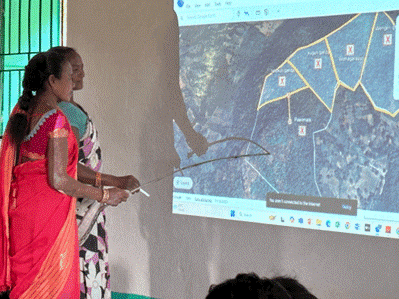
Integration into CFR Management Planning and CLANS Formation
Date: March 2026
Following a multi-day writeshop in March 2026, Landstack and FES completed the integration of the Stewardship Toolkit into formal CFRMP processes in Odisha and parallel CCAMP planning in Meghalaya — embedding community stewardship evidence directly into state-recognised forest governance documents. In parallel, CLANS (Consortium of Local Alliances for Nature Stewardship) was formally constituted in late 2025, bringing together Landstack, FES, RNBA, North East Network, Kenono Foundation, Better Life Foundation and Lemsachenlok. CLANS is now the primary vehicle for operationalising a dedicated Community Stewardship Fund across Nagaland, Manipur and Meghalaya, building on the global mandate established by IUCN Motion 105 (“Recognising and supporting community stewardship of natural resources through dedicated funding”), adopted at the 2025 IUCN World Conservation Congress in Abu Dhabi.