

Our approach

Stewardship can be understood as actions undertaken by individuals or groups to responsibly care for their environment for social as well as ecological outcomes. Enqvist et al. (2018) define stewardship through three key elements: an ethic of care, experiential knowledge, and the agency to take action.
Building on this framework, we have developed a Community Stewardship Assessment Toolkit, which combines 8 qualitative and quantitative methods to appreciate, understand and make visible the communities’ stewardship action. It includes resource mapping, care economy mapping, knowledge mapping, transect walks, household surveys, and biodiversity and biomass surveys, among other tools, to allow for an in-depth understanding of community-led management. This participatory action research methodology is continuing to evolve through several iterations.
Why stewardship
Communities have traditionally stewarded their natural resources for centuries, possessing deep knowledge and inherent skills to manage their ecosystems. However, these narratives and knowledge systems often go unrecognised, as intervention designers, including governments and NGOs, frequently approach these communities with preset solutions based on prevalent discourses and scientific knowledge. In recent years, climate finance has increasingly flowed into market-driven mechanisms like carbon markets, promoting Global North-driven nature-based solutions, without fully understanding diverse contexts and complex people-land-nature relationships. Market-led Climate action is currently driven by a strong demand side, bolstered by an army of intermediaries which are fast pervading tribal-dominated hinterlands of India and swaying communities as well as NGOs with the promise of financial incentives.
Landstack firmly believes that community led conservation action is central for combating climate change. However, there is an urgent need to flip the narrative in favour of communities by building strong evidence that demonstrates the effectiveness of communities’ continued conservation efforts.
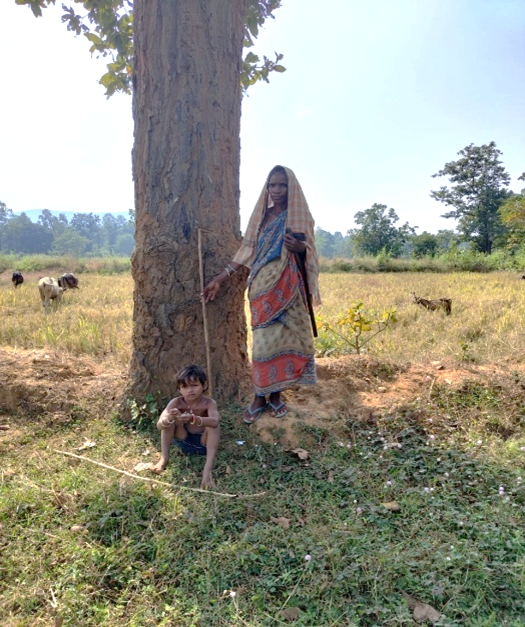

Our stewardship thinking
Piloting the tooklit
Over the past 1.5 years, we have deployed the Stewardship Assessment Toolkit in 18 villages across two Indigenous ecosystems in India—the Central Indian Tribal Belt and the Northeast. The toolkit was initially piloted in Odisha and Meghalaya in 2023, in partnership with the Foundation for Ecological Security (FES), and later expanded to Manipur in collaboration with Realm for Nature-Based Solutions (RNBA) and local NGOs.
Early results show that where communities invest consistent, culturally rooted effort in ecological care, nature responds with measurable biodiversity gains and visible forest recovery.

Dissemination across national and internaional platforms
We have disseminated widely our findings, which highlight the widespread presence of community stewardship, on various national and international platforms, including the World Bank Land Conference 2024, Dasra Philanthropy Week 2024, Commons Convening 2024 and the India Land and Development Conference (2022, 2023, and 2024).


Landstack recently featured on BBC’s Cool It Down podcast, now streaming on Spotify (https://lnkd.in/g_shjdVd), to discuss our approach of community stewardship and its relevance in today’s climate action era. In conversation with RJ Sayema, Pranab Ranjan Choudhury, the founder and CEO of Landstack and Dimgong Rongmei, an IPLC leader from Northeast India, shared insights on the role of traditional knowledge in biodiversity conservation, resource management, and climate resilience. Drawing from ongoing work in Odisha, Meghalaya, and Manipur, the discussion highlighted how community stewardship offers a win-win alternative in ecosystem services markets and conservation investments.
Building coalitions: National and regional collectives
Our knowledge advocacy efforts have sparked significant interest among national civil society organizations, philanthropies, and investors, leading to the formation of the Community Stewardship Coalition (CSC) in 2024. The coalition—founded by FES, Landstack, Climate Rise Alliance, Common Ground, and LGT Venture Philanthropy—aims to amplify the recognition of community stewardship and drive its large-scale adoption by engaging a broader network of stakeholders.
We are already witnessing strong interest in our approach across the Northeast region, where communities are traditionally conserving their landscapes for thanks to constitutional provisions safeguarding their customary tenure systems. To deepen the engagement with the region, we convened the Roundtable for North-east Region on Community Stewardship and PES Market in Guwahati in 2024, alongside Foundation for Ecological Security (FES), LGT Venture Philanthropy, and ClimateRISE Alliance, in collaboration with Realm of Nature Based Actions (RNBA) and SANJOG Assam (NE-RCRC). The roundtable provided a platform to share early learnings from our community-stewardship assessment toolkit, piloted in Meghalaya, Odisha, and Manipur. As a way forward, the collective committed to establishing a regional coalition on Community Stewardship in the Northeast—an especially timely development as the region is increasingly targeted by carbon project developers. Landstack aims to work actively to strengthen local capacities for assessing stewardship practices and engage with investors and policymakers to shape a community-driven narratives that ensures climate finance mechanisms work in favour of local communities.


Landstack’s coalition-building efforts were further strengthened through active participation in the 6th ICCA Southeast Asia Assembly (April 2025) in Lombok, Indonesia. Representing the Sendenyu CCA of Nagaland, one of our team members shared lived experiences of reviving culturally sacred lakes, regenerating forest biodiversity, and launching youth-led conservation education centers.
Building capacities: Training workshops on community stewardship and carbon markets
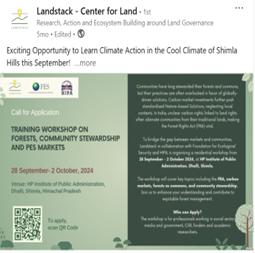
Training workshop at Himachal Institute of Public Administration (HIPA), Oct 2024
Last year, we also held a Training workshop on Forest governance, Community Stewardship and Carbon markets with the aim to bridge the gap between markets and communities, and equip development practitioners with a nuanced understanding of community stewardship and forest rights in collaboration with Foundation for Ecological Security (FES) and Himachal Institute of Public Administration (HIPA).

Stewardship toolkit and carbon markets orientation workshop at Tura, Feb 2025

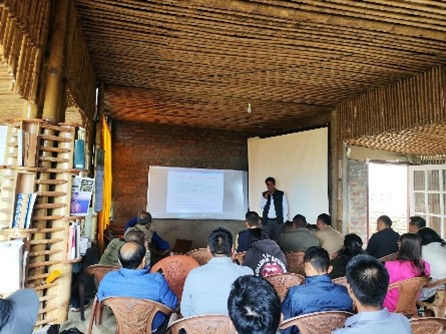
In February 2025, an Orientation Workshop on the Community Stewardship Toolkit was held in Tura, West Garo Hills, Meghalaya, bringing together CSOs from across Northeast India and Nepal. The aim of the workshop was to strengthen the evidence base for recognizing and supporting IPLC-led conservation in climate finance and policy spaces. Co-organized by Landstack and the Foundation for Ecological Security (FES), the workshop introduced the participants to the fundamentals of carbon markets, and concept of community stewardship while providing hands-on training in both qualitative and quantitative assessment tools from the Community Stewardship Toolkit. The workshop brought together a diverse and regionally grounded group of civil society organizations including Centre for Indigenous Peoples' Research and Development (CIPRED) from Nepal, as well as Better Life Foundation, Kenono Foundation, and Lemsachenlok Society from Nagaland. Participants emerged with a deeper understanding of how to document stewardship through participatory mapping, care economy tracking, and ecological monitoring techniques. More importantly, the workshop catalyzed a shared recognition of the urgent need to make IPLC-led stewardship more visible, verifiable, and valued in the climate action ecosystem.
Residential workshop on just engagement with the PES markets & restoration investments in NER
In May 2025, Landstack, in partnership with FES and Better Life Foundation Nagaland, co-hosted a Residential Workshop in Longkhim, Nagaland, focused on bridging knowledge and capacity gaps for meaningful engagement with PES markets. The workshop convened a vibrant cohort of around 10 Nagaland-based grassroots organizations, 5 universities, and 4 community leaders to collectively interrogate carbon markets, Free Prior and Informed Consent (FPIC), legal governance issues, and indigenous governance. The discussions underscored that carbon finance must be complementary, not extractive—and that only communities can define their terms of engagement.


Scaling and diversification of the stewardship toolkit with newer partnerships
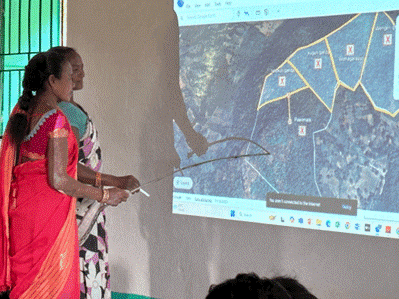
In 2025, the Stewardship Toolkit gained further traction through immersive field deployments in collaboration with Professional Assistance for Development Action (PRADAN) and Gram Vikas. These engagements went further deepened the existing toolkit, particularly through the integration of GIS-based participatory resource mapping. This approach allowed for spatially understanding the nuanced relationship, communities have with their forests, water sources, grazing patches, and other commons.
Rather than imposing technical templates, these pilots emphasized co-generation of forest management plans rooted in place-based knowledge systems and adaptive ecological practices. For the development practitioners involved, it signaled a powerful shift—a reversal of knowledge flows, where the community’s ecological logic and stewardship ethics guided the intervention (conservation/restoration) design. These efforts reaffirm stewardship not as a project add-on, but as a non-market, community-led strategy with the potential to inform equitable restoration investments and climate policy frameworks.
Multidisciplinary scaling of community stewardship assessment toolkit
The Stewardship assessment toolkit is seeing multidisciplinary adoption. A knowledge-sharing workshop held in the latter half of 2024 sparked significant interest from organizations working around livestock-dependent communities, small-scale fisheries and coastal commons. As a result, the Rainfed Livestock Network (RLN) and Azim Prem University (APU) have aligned the toolkit to capture stewardship narratives in pastoral and coastal ecosystems respectively.
We have also been a part of the regional convening organised by the Consortium for Agroecological Transformations (CAT) - Northeast Chapter in 2025 and the workshop on agro-ecology approaches for just transition hosted by the Kisan Mazdoor Commission (KMC) held in Delhi during December 2024, and are keen to explore our stewardship approach in agroecological systems.
Just as in forest governance, agroecology emphasizes the integration of local knowledge, sustainable practices, and ecological stewardship in agriculture. We believe the principles that underpin our Community Stewardship Assessment Toolkit can be applied effectively to agroecological systems, connecting cultural values and food systems, thereby generating evidence that recognizes the vital role farmers and communities play in maintaining healthy ecosystems through agroecological practices. Additionally, the toolkit can empower communities to assess their stewardship outcomes by monitoring the status of their biodiversity over time and at multiple scales.

Going forwward
As we continue to refine and expand the reach of our work, we call upon more like-minded organizations, stakeholders, and development practitioners to join us in this critical journey of empowering communities and recognizing their role as custodians of the land. By building strong, evidence-based narratives around community stewardship, we can challenge existing paradigms and foster the adoption of more inclusive, context-driven conservation practices.