
Landstack advisory
We work on both long-term research projects and short-term consultancy assignments. In recent years, our work has encompassed projects, partnerships and pro-bono engagements around the following themes
.png)
.png)
.png)
.png)

LATEST
PROJECTS

Building Partnership Ecosystem for Sustainable & Fair Sourcing of Maize from Small Farmers
The proposed program is designed to build and sustain an ecosystem, with a group of concerned actors in corporate, government, NGO and Academics, with interest and commitments towards sustainable and fair source of maize.
_JPG.jpg)
Balancing People, Profit, and Planet for Resilient Food Systems
Together with the University of Bern, Landstack completed a field study across three villages in Nagaland examining how expanding commercial agriculture is reshaping community-based ecosystem stewardship and what this means for sustainable food-system policy.

IncLand: Building state capacity for inclusive land administration
The project proposes to collaborate with two States of Odisha and Maharashtra; and three academic institutions to establish Land administration programmes and courses fostering interdisciplinary academic collaboration and inclusive land administration system.

Indigenous Peoples and Local Communities Nature Based Project Governance
The goal of the Conservation International study being conducted is to understand different approaches to Indigenous Peoples and Local Communities (IP&LC) governance in nature-based projects and to assess the level of integration of Indigenous Knowledge (IK).

Assessing relevance and impact of CADASTA platform vis-a-vis forest rights act implementation in India
The goal of this study is to analyze how CADASTA’s technology, in collaboration with local partners, influences decentralized processes of rights documentation and recognition, thereby promoting equitable outcomes.
PREVIOUS
PROJECTS


%20Impact%20Study.jpg)


Our Services
We work on both long-term research projects and short-term consultancy assignments. In recent years, our work has encompassed projects, partnerships and pro-bono engagements around the following themes
Building Partnership Ecosystem for Sustainable & Fair Sourcing of Maize from Small Farmers
The proposed program is designed to build and sustain an ecosystem, with a group of concerned actors in corporate, government, NGO and Academics, with interest and commitments towards sustainable and fair source of maize.
Balancing People, Profit, and Planet for Resilient Food Systems
Together with the University of Bern, Landstack completed a field study across three villages in Nagaland examining how expanding commercial agriculture is reshaping community-based ecosystem stewardship and what this means for sustainable food-system policy.

Responsible Land Procurement for RE
This study, led by Landstack in collaboration with CEEW, focuses on streamlining land procurement processes, aligning legal frameworks with RE policies, and developing responsible models for land acquisition, leasing, and pooling.

SAJAG: Socio-ecological action for just and green transformation
Landstack, in partnership with Godrej, is launching "Project Green Malanpur," an initiative to restore the ecological balance in 13 villages around the Malanpur industrial area.

Women Land Rights India: New Framework for Theory of Change
We developed a new Theory of Change (ToC) for Womanity that can be piloted and up scaled by a relevant actors, networks, and partnerships to drive equitable change with scalable impact at speed sustainably
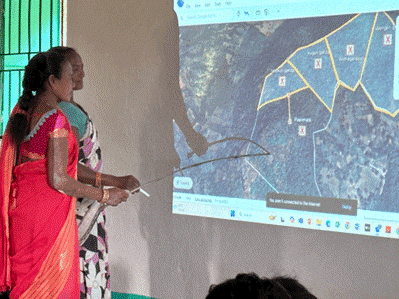
Community Stewardship Pilots
Landstack is working closely with the FES team as a strategic knowledge partner, to develop and refine the operational design, strategies, and implementation plan for stewardship pilots.
IncLand: Building state capacity for inclusive land administration
The project proposes to collaborate with two States of Odisha and Maharashtra; and three academic institutions to establish Land administration programmes and courses fostering interdisciplinary academic collaboration and inclusive land administration system.
Indigenous Peoples and Local Communities Nature Based Project Governance
The goal of the Conservation International study being conducted is to understand different approaches to Indigenous Peoples and Local Communities (IP&LC) governance in nature-based projects and to assess the level of integration of Indigenous Knowledge (IK).

Commons Typologies in India
The project aimed to develop a sub-typology of community land resource use rights recognized in India.The study included an analysis of the de jure and de facto realities of land management around commons, along with the nuanced legal frameworks that govern these areas.
Assessing relevance and impact of CADASTA platform vis-a-vis forest rights act implementation in India
The goal of this study is to analyze how CADASTA’s technology, in collaboration with local partners, influences decentralized processes of rights documentation and recognition, thereby promoting equitable outcomes.